Why Kansas City Gutters Clog So Fast
Kansas City's tree canopy covers roughly 31 percent of the city, and older neighborhoods like Brookside, Waldo, Hyde Park, Armour Hills, Roanoke, and much of the Northland sit under mature oaks, silver maples, sycamores, and cottonwoods. Every spring those trees drop seed pods and samaras that pack into a gutter like wet paper. Every fall they drop leaves. Add asphalt shingle granules, roof grit, twigs, and the occasional nest, and a bare gutter under a mature canopy can clog twice a year without much trouble at all.
What a Clogged Gutter Actually Costs You
A clogged gutter is not just a ladder chore waiting to happen. Standing water rots fascia boards from the back side where you can't see it, backs up under the shingle line at the roof edge, freezes into ice loading that can pull an entire run off the house, and sends overflow straight down to the foundation instead of away from it. What looks like a leaf problem in October can turn into a fascia, roof edge, or foundation problem by the following summer.
Are All Gutter Guards the Same?
No, and the differences matter more in Kansas City than in a milder climate. Reverse-curve and surface-tension guards are widely considered a poor fit for climates with sustained freezing temperatures, and Kansas City averages roughly 18 inches of seasonal snowfall with repeated freeze-thaw cycles. Durable mesh and micro-mesh guards handle fine debris like shingle granules, seed pods, and pine needles rather than just whole leaves, and they let Kansas City's short-burst rainfall, which can approach seven inches per hour in a design storm, pass through the full width of the gutter instead of being forced around a curved nose.
What Gutter Guards Do — and Do Not Do
- They do end the annual ladder chore of scooping out packed leaves and seed pods by hand
- They do keep water flowing during heavy Kansas City rain, so long as the gutter beneath them is the right size and pitch
- They do reduce standing water, which means less fascia rot, less ice loading, and less weight pulling on your hangers
- They do not make a gutter maintenance-free forever; debris can still sit on top of the mesh, and an occasional rinse from the ground keeps them flowing
- They do not fix an undersized gutter, a bad pitch, too few downspouts, or a missing gutter apron on their own
What Gutter Guards Cost in Kansas City
Professionally installed gutter guards in the Kansas City metro generally run 7 to 14 dollars per linear foot depending on the guard type, with micro-mesh at the top of that range and perforated aluminum and screen systems lower. On a typical 180 to 220 foot home, expect roughly 1,300 to 3,000 dollars for the full project. Locally installed mesh guard systems routinely come in well below the per-foot pricing charged by large national gutter protection brands for a comparable product.
Do Gutter Guards Pay for Themselves?
For a home under mature trees that currently needs cleaning twice a year at roughly 150 to 250 dollars per visit, that's 300 to 500 dollars a year in ongoing cleaning cost. Against a one-time guard installation in the 1,300 to 3,000 dollar range, many Kansas City homes reach a rough break-even somewhere between four and eight years, and every year after that is close to pure savings, not counting the reduced risk of ice loading and fascia rot along the way. Homes without much overhanging canopy, which need cleaning only once a year, take longer to break even and should weigh the decision differently.
Gutter Guards or a Whole New Gutter System?
If your gutters are sound, correctly sized, and correctly pitched, guards are a straightforward upgrade on the existing system. If your gutters are old sectional runs already leaking at the seams, installing guards over a failing system just protects a problem you'll still have to fix later. In that case, new seamless gutter with guards installed at the same time typically costs less than doing the two jobs separately, and it gives you one system that actually works together.
Will I Ever Need to Clean My Gutters Again With Guards Installed?
Occasionally, yes. Guards are not maintenance-free forever. Fine debris can still settle on top of the mesh over a season or two, and a quick brush or hose rinse from the ground once a year keeps a guarded system performing the way it should. That is a very different task from climbing a ladder to hand-scoop packed, wet debris out of an open trough, but it isn't nothing.
A Recent Kansas City Metro Gutter Guard Project
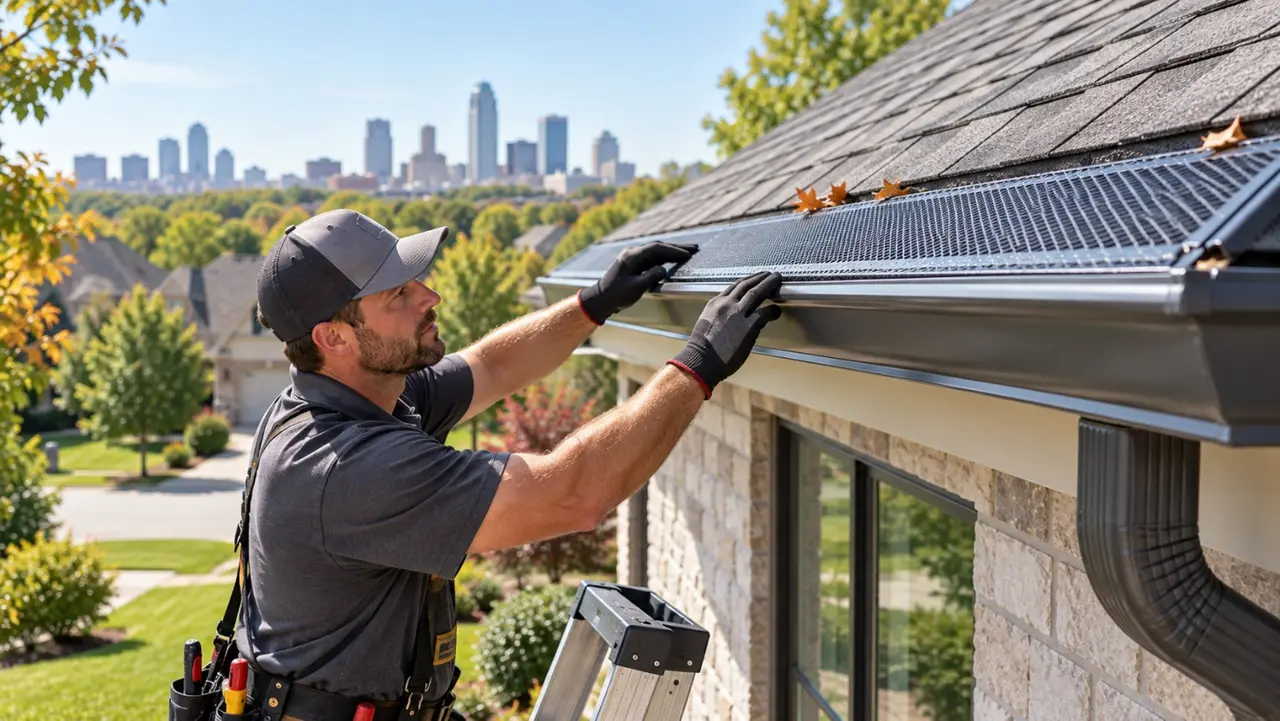
On a recent project in Leawood, KS, our crew fitted durable mesh guards along a steep-pitched roofline that had been clogging heavily every season. Each piece was fitted and secured individually to keep a consistent seal along the roof edge, ending the homeowner's recurring clogging problem and cutting their maintenance down to an occasional check rather than a twice-yearly ladder job.
Which Kansas City Homes Benefit Most From Gutter Guards
- Homes under mature canopy in neighborhoods like Brookside, Waldo, Hyde Park, Armour Hills, and Roanoke
- Two-story and three-story homes, where climbing a ladder to clean gutters carries the most risk
- Rental properties and second homes where an owner can't inspect gutters as often as they'd like
- Homes with roof valleys that funnel an outsized amount of debris into one short gutter run
How Gutter Guards Hold Up Through a Kansas City Winter
Winter is where the difference between guard types shows up most clearly. Mesh guards sit flat against a properly pitched gutter, so snow load and occasional icing don't have much leverage to peel them away from the roofline. Reverse-curve designs rely on water clinging to a curved surface and dropping into the gutter below, a mechanism that becomes unreliable once ice starts forming on that curve, which is exactly the scenario Kansas City's freeze-thaw winters create several times a season.
What Installation Day Looks Like
Guards are fitted piece by piece along the roofline rather than snapped on as one continuous strip, which matters on the steep-pitch roofs common across the Kansas City metro. Each section is aligned and secured individually so the guard sits flush against the gutter's front lip along its entire length, without gaps where debris could work its way underneath during a heavy rain.
Should You Install Guards on an Older Sectional System?
It depends entirely on the condition of what's underneath. If a sectional system is still structurally sound, with no active leaks and a correct pitch, adding guards can meaningfully extend how long it performs well before replacement is needed. If it's already leaking at multiple seams or showing rust and dents across several runs, guards installed on top just protect a system that was already on borrowed time, and the smarter move is usually pairing new seamless gutter with guards in a single project.
How Guard Installation Affects an Existing Warranty
Reputable gutter guard installation shouldn't affect a roof's shingle warranty, since guards attach to the gutter itself rather than to the roof or under the shingle line. That said, it's worth asking any installer, including us, to confirm exactly how a specific guard system attaches before work begins, especially on a roof that's still within its manufacturer warranty period.
A Simple Way to Check If You Need Guards
If you've cleaned your gutters more than once in the last twelve months, or you can see debris building up from the ground after a windy week, that's usually a strong enough signal on its own to look seriously at guards, without needing to wait for a clogged downspout or an overflow event to make the decision for you.
Getting Gutter Guards Installed in Kansas City
If you're tired of the twice-a-year ladder chore, or you want to protect a new seamless system from day one, request a free gutter guard estimate or contact Integrity Exteriors to have an owner assess your roofline and recommend the right guard for your trees, your pitch, and your budget.