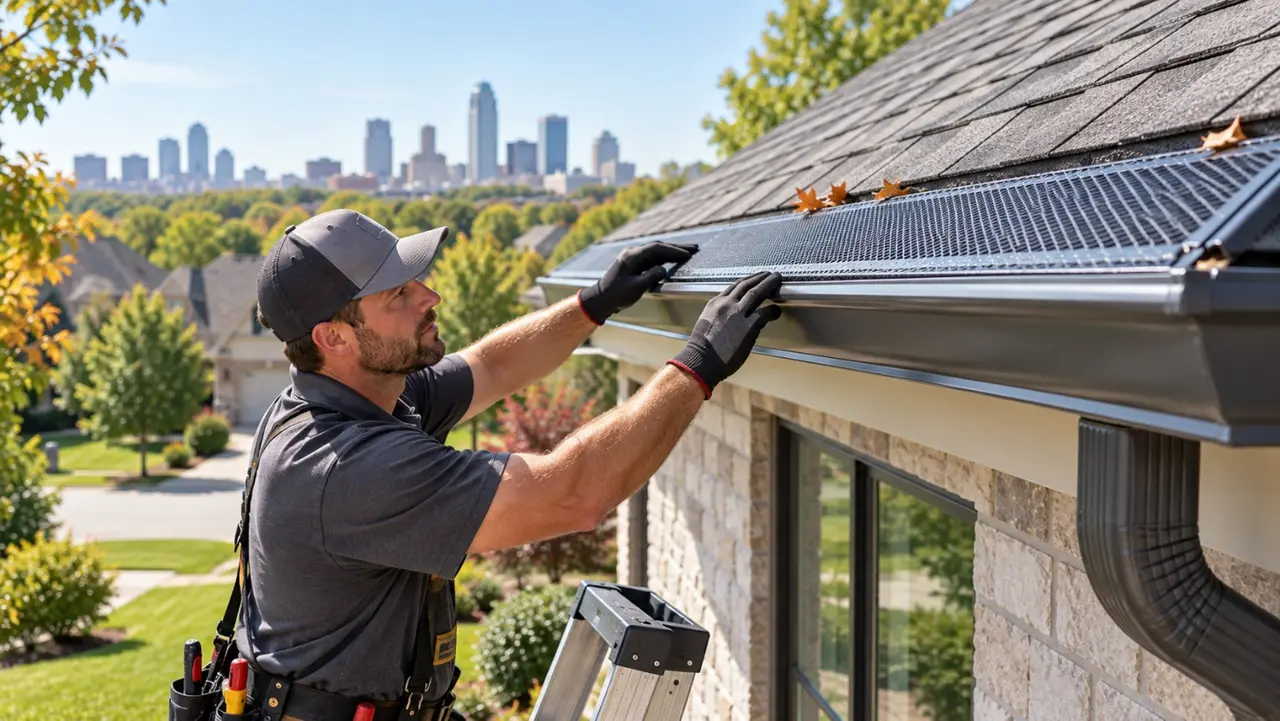
What Are Gutter Guards and How Do They Work?
Gutter guards, also called gutter covers or leaf guards, are panels installed over the open top of a gutter. Their job is simple: let rainwater in while keeping leaves, seed pods, twigs and roof grit out. When a guard works the way it should, water reaches your downspouts freely, your gutters stay clear between storms and you spend far less time on a ladder.
Every guard design handles this job differently. Some use fine stainless steel mesh, some rely on perforated aluminum, and others use a curved hood that guides water around a bend while debris slides off the edge. The design you pick determines how well your system holds up to Kansas City's mix of heavy spring rain, autumn leaf drop and winter ice.
Why Kansas City Gutters Clog So Fast
Kansas City neighborhoods are known for their mature tree canopy. Pin oaks, silver maples, sweetgums, cottonwoods, honeylocusts and black walnuts line streets from Brookside and Waldo to Prairie Village, Leawood and the Northland. Each tree adds something different to your gutters throughout the year:
- Spring: maple helicopters, oak tassels and cottonwood fluff that mat together into a dense, water-blocking layer.
- Summer: heavy thunderstorms wash shingle granules and small twigs into the trough, especially after hail.
- Fall: the main leaf drop, which can fill an unprotected gutter in a single windy week.
- Winter: leftover debris holds moisture, freezes in place and adds weight to hangers and fascia.
The metro also averages close to 40 inches of precipitation a year, with intense downpours in May and June. A gutter that is half full of debris cannot handle that volume, so water spills over the front edge and lands right next to your foundation. Kansas City's clay-heavy soil swells when it gets wet, which is why clogged gutters so often lead to damp basements and cracked foundation walls.
Types of Gutter Guards and How They Perform in Kansas City
Micro-Mesh Gutter Guards
Micro-mesh guards use a fine stainless steel screen stretched over an aluminum frame. They block leaves, pine needles, seed pods and most shingle grit while still letting heavy rain pass through. For homes under oaks and maples, micro-mesh is the most dependable option. Installed cost in the Kansas City area usually falls between $9 and $14 per linear foot.
Perforated Aluminum and Screen Guards
These guards use larger holes punched into aluminum or a wire screen. They stop big leaves well, but smaller debris such as maple seeds and oak tassels can slip through or lodge in the openings. Expect roughly $5 to $9 per linear foot installed. They are a reasonable budget choice for homes with light tree cover.
Reverse-Curve and Surface-Tension Guards
Reverse-curve guards cover the gutter with a solid hood. Water clings to the curved nose and flows into a narrow slot, while debris is meant to fall off the edge. In very heavy Kansas City rain, water can overshoot the curve, and the narrow slot can ice over during freeze-thaw cycles. They also tend to be among the most expensive systems.
Foam and Brush Guards
Foam inserts and brush guards sit inside the gutter. They are inexpensive and easy to install, often $2 to $4 per foot, but they trap fine debris, can grow moss and usually need replacement within a few years. For most Kansas City homeowners, they are a short-term fix rather than a long-term solution.
Gutter Guard Cost in Kansas City: 2026 Breakdown
Most professionally installed gutter guards in the Kansas City metro cost $7 to $14 per linear foot, depending on guard type, roof height and the condition of your existing gutters. Here is what typical homes can expect:
- Ranch home, about 150 linear feet: $1,050 to $2,100.
- Two-story home, about 200 linear feet: $1,400 to $2,800.
- Large or complex roofline, 250+ linear feet: $1,750 to $3,500 or more.
Several factors move your price up or down:
- Guard material: stainless micro-mesh costs more than perforated aluminum or foam.
- Home height: two- and three-story homes require more safety equipment and labor.
- Roof pitch and complexity: steep roofs, valleys and multiple corners add time.
- Gutter condition: loose hangers, leaking seams or rotted fascia must be repaired before guards go on.
- New gutters or existing gutters: pairing guards with new seamless gutters often lowers the combined labor cost.
Pros of Gutter Guards for Kansas City Homes
- Fewer cleanings: most homes go from two or three cleanings a year to an occasional rinse.
- Less overflow: clear gutters move storm water to downspouts instead of over the front edge.
- Foundation protection: controlled drainage keeps water away from expansive clay soil and basement walls.
- Reduced ladder risk: fewer climbs onto steep or two-story rooflines.
- Longer gutter life: less standing water and wet debris means less corrosion and less weight on hangers.
- Fewer pests: dry, clean gutters do not attract mosquitoes, birds or rodents.
Cons and Limitations of Gutter Guards
- Upfront cost: quality guards are a real investment, especially on large homes.
- Not maintenance-free: fine pollen, shingle grit and seed fluff can coat the surface and need a periodic rinse.
- Overshoot risk with poor designs: some hood-style guards let water run past the gutter in heavy rain.
- Ice buildup: guards will not stop ice dams caused by attic heat loss; insulation and ventilation solve that problem.
- They cannot fix a bad system: undersized, sagging or improperly pitched gutters will still overflow with guards on top.
Do Gutter Guards Pay for Themselves?
Professional gutter cleaning in Kansas City usually costs $100 to $300 per visit. Homes under heavy tree cover often need two or three cleanings a year, which adds up to $300 to $900 annually. A $1,400 to $2,800 guard system can recover its cost in roughly three to six years through cleaning savings alone.
The bigger financial benefit is what guards help you avoid. Overflowing gutters can rot fascia boards, stain siding, erode landscaping and send water into basements. Fascia replacement, foundation crack repair and basement waterproofing can each cost far more than a full set of guards. When you add those avoided repairs to the equation, guards make strong financial sense for most tree-covered Kansas City properties.
When Gutter Guards Are Not Worth It
Guards are not the right answer for every home. They may not be worth it if:
- Your home has no large trees nearby and your gutters stay clear with one cleaning a year.
- Your current gutters are leaking, sagging or rusting and will need replacement soon.
- Your gutters are undersized and already overflow when they are clean.
- You plan to sell the home in the next year or two and a cleaning will serve the same purpose.
Should You Add Guards to Existing Gutters or Install New Seamless Gutters?
If your gutters are sound, correctly sized and properly pitched, adding guards is a straightforward upgrade. If they are older sectional gutters that leak at the seams, guards simply protect a system that is already failing. In that case, the smarter investment is usually new 5-inch or 6-inch seamless aluminum gutters installed with guards in a single project. You pay for one setup, get one consistent system and avoid paying to remove guards when the gutters eventually fail.
How to Choose a Gutter Guard Installer in Kansas City
Look for a local, experienced gutter company that inspects your full system before recommending a guard. A trusted installer should check gutter size, pitch, downspout placement and fascia condition, explain which guard fits your tree cover and give you a written, itemized estimate. Ask about workmanship coverage, how the guard attaches to your roof edge and whether the installation affects your shingle warranty.
Frequently Asked Questions
Are gutter guards worth it in Kansas City?
Yes, for most homes with nearby trees. Kansas City's oaks, maples and cottonwoods fill gutters quickly, and guards reduce cleanings, overflow and foundation water problems.
How much do gutter guards cost in Kansas City?
Professionally installed gutter guards in the Kansas City metro typically cost $7 to $14 per linear foot, or about $1,050 to $2,800 for an average home.
Do I still need to clean gutters with guards installed?
You will clean far less often. Most guards need an occasional rinse or brushing to remove pollen, grit and fine seed fluff, usually once every one to two years.
What type of gutter guard works for Kansas City weather?
Stainless steel micro-mesh guards handle Kansas City's heavy rain and fine tree debris well and are less prone to overshoot and slot icing than reverse-curve designs.
Can gutter guards go on my existing gutters?
Yes, if your gutters are in good condition and correctly pitched. If they leak or sag, replacing them with seamless gutters and guards together is usually the better value.