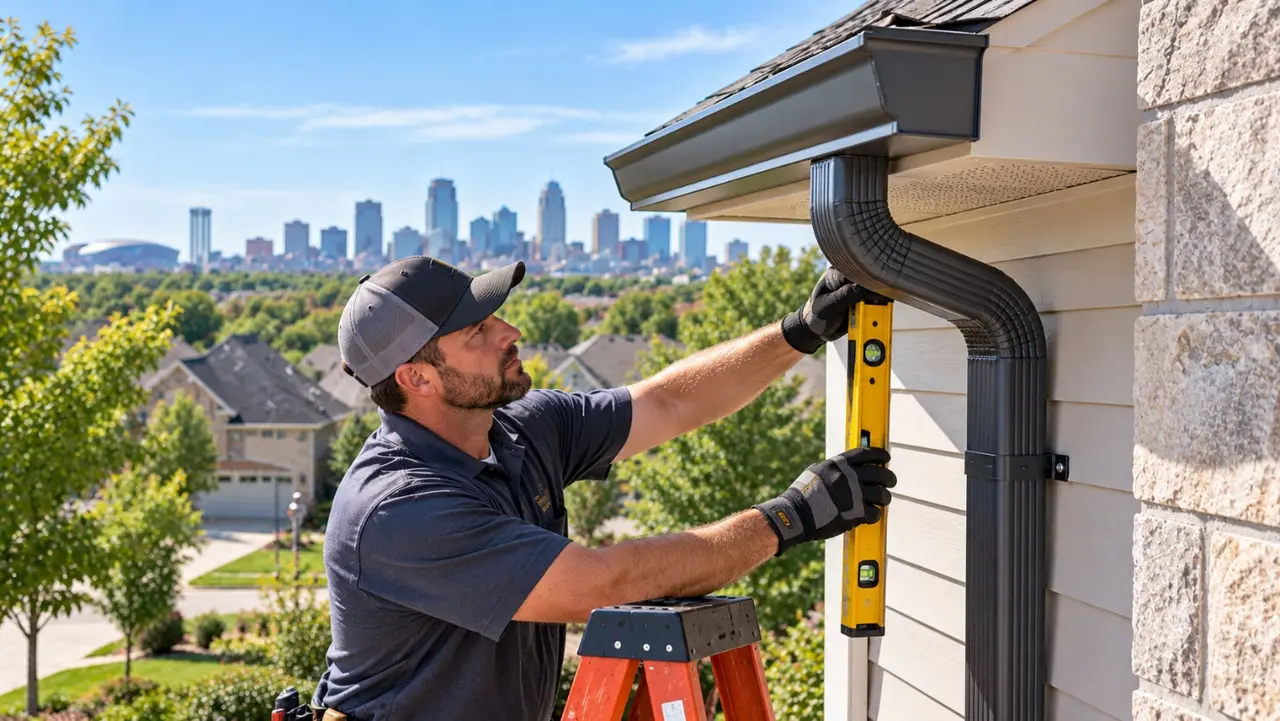
Why Gutter Size Matters So Much in Kansas City
Gutter size is not a cosmetic choice. It decides how much water your system can carry before it spills over the front edge. Kansas City averages close to 40 inches of precipitation a year, and spring and early summer storms can drop well over an inch of rain in a short burst. When a gutter is too small for the roof above it, those storms overwhelm the system even when the gutter is perfectly clean.
Overflowing water lands next to your foundation, splashes mud onto siding, erodes mulch beds and soaks into the clay soil common across the metro. That clay expands when wet and pushes against basement walls. The right gutter size is one of the simplest ways to protect your home from these problems.
5-Inch vs. 6-Inch Gutters at a Glance
5-Inch K-Style Gutters
- Hold about 1.2 gallons of water per linear foot.
- Typically paired with 2x3-inch downspouts.
- Common on ranch homes, split-levels and smaller roof planes.
- Lower cost and a slimmer profile on the fascia.
6-Inch K-Style Gutters
- Hold about 2.0 gallons of water per linear foot.
- Typically paired with 3x4-inch downspouts, which drain roughly twice as fast as 2x3 downspouts.
- Suited to two-story homes, steep pitches, large roof areas and valleys.
- Handle more debris before clogging and work well with gutter guards.
How to Know Which Gutter Size Your Home Needs
An experienced gutter installer considers four main factors before recommending a size.
1. Roof Area Draining Into Each Gutter Run
The larger the roof plane feeding a gutter, the more water that gutter must carry. A small ranch roof split into several short runs rarely needs more than 5-inch gutters. A long, uninterrupted roof plane on the back of a two-story home sends a much larger volume into a single run, and that is where 6-inch gutters earn their place.
2. Roof Pitch
Steeper roofs shed water faster and with more force. On a steep pitch, rain races down the shingles and can shoot past a narrow gutter. Many newer homes in Olathe, Overland Park, Lee's Summit and Shawnee have steep, complex roofs that benefit from the wider opening and deeper trough of a 6-inch gutter.
3. Roof Valleys and Concentrated Flow
Valleys channel water from two roof planes into one narrow stream. Where a valley empties onto a gutter, the flow at that single point can be several times higher than anywhere else on the run. A 5-inch gutter often overflows at these spots first. Upsizing to 6-inch gutters, adding a valley splash guard or adding a downspout near the valley usually solves the problem.
4. Overflow History and Tree Cover
If your current gutters overflow in heavy rain even after a cleaning, that is a strong sign they are undersized or lack enough downspouts. Homes under heavy tree cover also benefit from 6-inch gutters because the wider trough takes longer to clog and pairs well with micro-mesh guards.
Downspouts Matter as Much as Gutter Size
A gutter can only drain as fast as its downspouts allow. A standard 2x3 downspout handles a modest amount of roof area, while a 3x4 downspout moves roughly twice the water. Many Kansas City homes built with builder-standard 5-inch gutters and only one 2x3 downspout per run overflow simply because the outlet is too small.
In some cases, keeping 5-inch gutters but upgrading to 3x4 downspouts or adding an extra downspout fixes the overflow at a lower cost than a full system upgrade. A trusted installer will look at both sides of the equation before recommending new gutters.
Cost Difference Between 5-Inch and 6-Inch Gutters in Kansas City
In the Kansas City metro, seamless aluminum gutters generally cost $10 to $20 per linear foot installed. Choosing 6-inch gutters typically adds $2 to $5 per linear foot because of the wider aluminum coil, heavier hangers and larger downspouts.
- 150 linear feet of 5-inch seamless gutters: about $1,500 to $2,700.
- 150 linear feet of 6-inch seamless gutters: about $1,800 to $3,400.
- 200 linear feet of 6-inch seamless gutters on a two-story home: about $2,800 to $4,600.
For most homes that need the extra capacity, the added cost is small compared with the price of fascia repair, landscape regrading or basement waterproofing caused by repeated overflow.
How Long Do 5-Inch and 6-Inch Gutters Last?
Both sizes of seamless aluminum gutters typically last 20 to 30 years in the Kansas City climate when they are installed with quality hidden hangers and maintained properly. Six-inch gutters often last slightly longer in practice because they overflow less, carry less standing water against the fascia and put less strain on hangers during heavy storms. Heavier-gauge aluminum coil also adds resistance to hail dents and ladder damage.
Do 6-Inch Gutters Look Too Big?
This is one of the most common concerns. On a two-story home or a home with wide fascia boards, 6-inch gutters look proportional and often blend in better than a thin 5-inch profile. On a small single-story ranch with narrow fascia, a 6-inch gutter can appear heavy. Color matching to your trim, fascia or roof edge minimizes the visual difference in either case.
When 5-Inch Gutters Are the Right Choice
- Single-story homes with low to moderate roof pitch.
- Roofs broken into several small sections with short gutter runs.
- Homes with no history of overflow when gutters are clean.
- Projects where budget is the main concern and capacity needs are modest.
When 6-Inch Gutters Are the Right Choice
- Two-story and three-story homes with large roof planes.
- Steep roofs, metal roofs or roofs with multiple valleys.
- Homes that overflow in heavy rain even when gutters are clean.
- Properties under heavy tree cover or homes adding gutter guards.
- Homes with drainage, grading or basement moisture concerns.
Gutter Size Recommendations by Kansas City Home Type
Older Bungalows and Ranch Homes
Many homes in Brookside, Waldo, Raytown, Prairie Village and Mission were built with modest roof areas and lower pitches. These homes usually perform well with 5-inch seamless gutters, provided each run has enough downspouts and the gutters are pitched correctly toward the outlets.
Two-Story Suburban Homes
Two-story homes in Olathe, Overland Park, Lee's Summit, Blue Springs and Liberty often have tall, steep roof planes that shed a large volume of water quickly. Six-inch gutters with 3x4 downspouts are the standard recommendation for these homes, especially on rear elevations with long, uninterrupted runs.
Custom and Luxury Homes
Larger homes in Leawood, Mission Hills and Parkville frequently feature multiple valleys, dormers and steep pitches. These rooflines concentrate water in specific spots, so 6-inch gutters combined with additional downspouts and valley splash guards provide the capacity and control they need.
Common Gutter Sizing Mistakes to Avoid
- Matching the old system by default: replacing undersized gutters with the same size repeats the overflow problem.
- Ignoring downspouts: a larger gutter with too few or too small outlets still backs up during heavy rain.
- Sizing for the average storm: gutters should handle intense Kansas City downpours, not just light rain.
- Mixing sizes without a plan: different sizes on connected runs can create bottlenecks at corners.
- Skipping the pitch check: even a properly sized gutter overflows if it is hung level or sloped away from the outlet.
Why Seamless Gutters Make Either Size Perform Better
Whichever size you choose, seamless gutters formed on-site to the exact length of your roofline perform better than sectional gutters. With joints only at corners and outlets, there are far fewer places for leaks to start. That matters in Kansas City, where freeze-thaw cycles constantly expand and contract metal and stress sealed seams.
Get the Right Gutter Size the First Time
Choosing gutter size by guesswork often leads to paying twice. An experienced gutter professional measures roof area, checks pitch, identifies valleys, reviews your overflow history and recommends a gutter and downspout combination that matches how much water your roof actually sheds.
Frequently Asked Questions
Do I need 6-inch gutters in Kansas City?
You likely need 6-inch gutters if your home is two stories, has a steep or complex roof, has valleys, or overflows in heavy rain even when the gutters are clean.
How much more do 6-inch gutters cost than 5-inch gutters?
In Kansas City, 6-inch seamless gutters typically cost $2 to $5 more per linear foot than 5-inch gutters, mainly for wider material, stronger hangers and larger downspouts.
How much water does a 6-inch gutter hold?
A 6-inch K-style gutter holds about 2.0 gallons per linear foot, compared with about 1.2 gallons for a 5-inch K-style gutter.
What size downspout goes with 6-inch gutters?
Six-inch gutters are usually paired with 3x4-inch downspouts, which drain roughly twice the water of standard 2x3-inch downspouts.
Can bigger downspouts fix overflowing 5-inch gutters?
Sometimes. Upgrading to 3x4 downspouts or adding outlets can solve overflow on 5-inch gutters if the trough itself has enough capacity for the roof area.