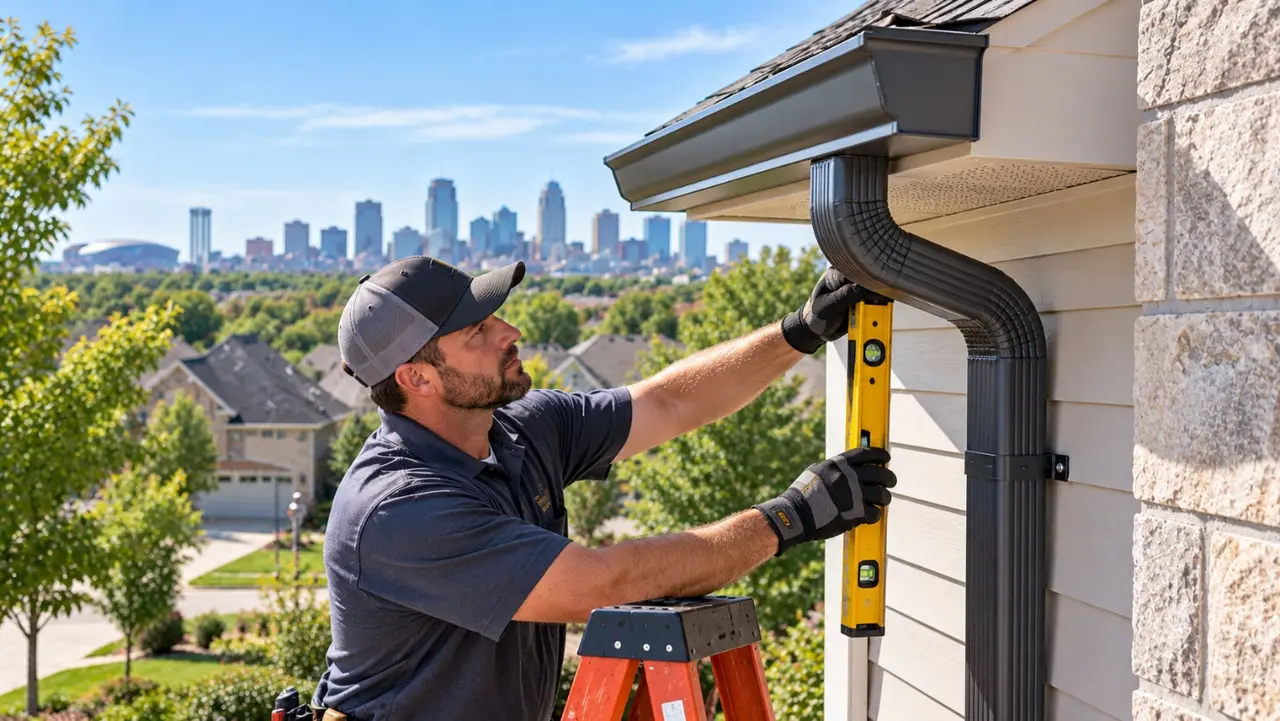
Why Gutter Sizing Is Not One-Size-Fits-All in Kansas City
Two homes with the same square footage can need completely different gutter systems depending on roof pitch, roofline complexity, and how much of the roof drains into a single run. A steep roof moves water faster than a shallow one, and a roof with several valleys funneling into one gutter run needs more capacity at that section than the rest of the house. Sizing based on a rule of thumb instead of the actual roof is one of the most common reasons a system overflows even when it's brand new.
5-Inch vs. 6-Inch K-Style Gutters: How to Choose
A 5-inch K-style gutter carries roughly 1.2 gallons per linear foot and serves up to about 5,520 square feet of effective roof area, which is enough for most standard Kansas City homes. A 6-inch oversized K-style gutter carries roughly 2.0 gallons per linear foot and serves up to about 7,960 square feet, making it the better choice for larger roofs, steep pitches, or homes that have already experienced overflow with a smaller system. Choosing between the two should come down to your actual roof area and pitch, not just matching whatever size is already on the house.
How Downspout Size Changes What a Gutter Can Handle
A standard 2x3 downspout drains roughly 600 square feet of roof, while an oversized 3x4 downspout drains roughly 1,200 square feet and moves three to four times the volume. A gutter sized correctly for the roof can still overflow if it's paired with too few downspouts, or with downspouts too small for the volume of water reaching them during a heavy Kansas City storm.
How Many Downspouts Does a Kansas City Home Actually Need?
The right number depends on total roof area, the number of valleys directing water into specific sections, and the length of each individual run, not a flat rule like "one downspout per side of the house." A long run with a valley dumping into the middle of it may need a downspout near that valley in addition to the ones at each end, since asking the water to travel the full length of the run before draining invites overflow along the way.
Why Pitch Matters as Much as Size
A gutter that's the right size but pitched incorrectly still won't perform. Every run needs a deliberate, consistent fall toward its outlet so water actually moves instead of standing. A flat or reverse-pitched section holds water long after a storm has passed, adds constant weight to the hangers, and is one of the most common causes of a gutter pulling away from the fascia over time.
What Happens When a Gutter Is Undersized for the Roof
- Water overshoots the gutter during Kansas City's short-burst storms, which can approach seven inches of rainfall per hour
- Constant overflow strains hangers and accelerates fascia rot behind the gutter
- Water is pushed toward the foundation instead of away from it, increasing the risk of basement seepage
- The system looks fine when it's dry but fails predictably every time a real storm hits
Getting Downspout Placement Right the First Time
Placement matters as much as size. A downspout that discharges onto a walkway, a driveway, or straight toward the foundation just moves the water problem a few feet instead of solving it. Integrity Exteriors plans discharge locations, and extensions where needed, so water actually leaves the area around your home rather than pooling next to it.
How We Size Every Kansas City Installation
Every estimate starts with measuring each run, counting corners and outlets, and assessing roof pitch and total roof area on site, rather than quoting from a phone call. From there, gutter size, downspout size, downspout count, and discharge locations get recommended based on the actual roof and Kansas City's rainfall intensity, not a default package. Request a free estimate to have an owner walk your roofline in person.
Common Sizing Mistakes We See on Existing Kansas City Homes
- A 5-inch gutter installed on a large or steep roof that really calls for a 6-inch system
- Too few downspouts for the total roof area, especially on long runs with multiple valleys
- A downspout undersized for the section of roof it's draining
- A run with a flat or barely-there pitch that lets water sit instead of drain
Why Getting This Right the First Time Saves Money Later
Correcting an undersized or poorly placed gutter system later almost always costs more than sizing it correctly during the original installation, since it often means re-hanging entire runs, adding downspouts after the fact, or repairing fascia and foundation issues that developed while the system was overflowing. Getting the sizing and placement right the first time avoids all of that, and it's the difference between a gutter system that quietly does its job and one that needs attention every time it rains hard.
How Roof Pitch Changes the Sizing Math
A steep roof sheds water much faster than a shallow one, which means the same square footage of roof area can arrive at the gutter with meaningfully more force and volume on a steep pitch than on a gentle one. Sizing that ignores pitch and looks only at square footage can leave a steep-roofed home with a gutter that's technically rated for the area but still overwhelmed during a hard, fast Kansas City downpour.
Why Valleys Deserve Extra Attention When Sizing
A roof valley concentrates water from two separate roof planes into a single point, which means the gutter run beneath a valley often needs to handle noticeably more volume than a run of the same length elsewhere on the house. Treating every run on a home identically, without accounting for which ones sit beneath a valley, is a common oversight that shows up later as one specific section that always overflows first.
What Happens When Sizing Is Right but Placement Is Wrong
Even a correctly sized gutter with well-placed downspouts can create a new problem if the discharge point sends water toward a walkway, a low spot in the yard, or a neighboring property line. Extensions, splash blocks, or tying into an underground drain line are all reasonable solutions, but they only work if placement was actually considered during installation rather than treated as an afterthought once the gutter itself was already up.
Sizing Considerations for Additions, Dormers, and Sunrooms
Adding a dormer, a sunroom, or any expansion to a roofline changes the total area draining into the existing gutter system, and the original sizing may no longer be adequate once that new roof area is added in. A gutter that handled the original roof comfortably can start overflowing after an addition simply because it's now serving more square footage than it was ever sized for, which is worth checking any time a home's roofline changes.
Why an On-Site Estimate Beats a Phone Quote for Sizing
Roof area, pitch, valley placement, and existing fascia condition are difficult to judge accurately over the phone or from a satellite photo, which is why Integrity Exteriors measures every run in person before recommending a size. A quote built without walking the roofline is really a guess dressed up as a number, and sizing mistakes made at that stage are exactly the ones that show up later as overflow or repeat repairs.
A Quick Way to Spot a Sizing Problem on Your Own Home
If one particular section of gutter overflows before the rest of the house during a hard rain, that section is almost always either undersized for the roof area feeding it, positioned under a valley without enough extra capacity, or missing a downspout that the rest of the run has. Noticing which section fails first is often enough to point a trained eye straight to the fix, rather than treating the whole system as a mystery.
Bringing It All Together
Gutter size, downspout size and count, pitch, and discharge placement all work as one system, and getting one of the four right while ignoring the others still leaves room for overflow, standing water, or foundation risk. The homes that never think about their gutters again after installation are almost always the ones where all four were considered together from the start.
Getting Your Kansas City Gutters Sized Correctly
Whether you're installing new gutters or trying to figure out why your current system overflows, contact Integrity Exteriors or request a free estimate for a sizing and placement plan based on your actual roof, not a one-size default.